Five Modern Highways to Majestic Rainier
Pages (3)
Background
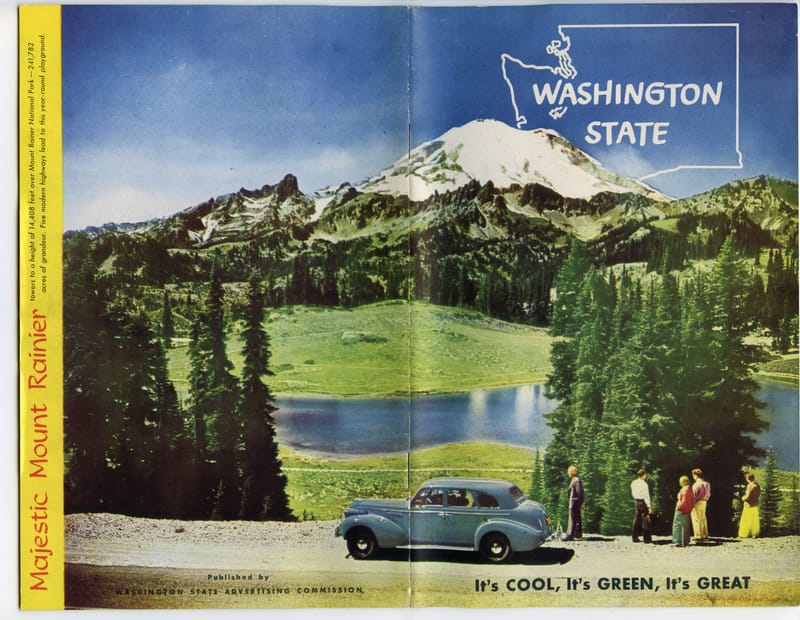
A pale-blue late-1930s sedan sits on a gravel overlook while four visitors face Mount Rainier across an alpine lake — the cover of a Washington State Advertising Commission brochure that promised "five modern highways" to the mountain's "year-round playground."
The Washington State Advertising Commission was the state's tourism-promotion body in the years before wartime gasoline and rubber rationing ended the era of the pleasure drive. The slogan in the lower right — "It's COOL, It's GREEN, It's GREAT" — pitched Washington directly to visitors from warmer, drier states. The mountain's elevation is printed as 14,408 feet, the figure derived from earlier barometric surveys; GPS-era measurements now read 14,411. The park acreage is given as 241,782 — somewhat higher than today's official 235,625 acres, most likely reflecting boundary adjustments made in the decades since.
The lake in the cover photograph is almost certainly Reflection Lakes — a pair of small tarns on the south side of the park, accessible from the Paradise road, that offered visitors a still-water mirror image of the volcano. A boat concession ran there from 1927 onward; by the 1930s the site was one of the park's most visited stops. The secondary jagged ridge visible to Rainier's left is likely the Tatoosh Range, which frames the view from the south side.
The "five modern highways" mentioned on the yellow strip are the paved approach roads entering the park from different directions. Road construction at Mount Rainier expanded significantly through the 1920s and 1930s, and New Deal programs — the Civilian Conservation Corps established eight camps in the park — added labor and materials. By the late 1930s, annual visitation was measured in the hundreds of thousands, and automobile access was the dominant way people arrived.
The sedan in the foreground — rounded, streamlined, with fenders beginning to blend into the body — matches the American car silhouette of roughly 1939–1941, when manufacturers moved from the fully separate fender toward a more integrated body. By 1942 rubber rationing and fuel restrictions had made road-trip tourism brochures effectively obsolete for the duration of the war, placing this piece squarely in the pre-war automobile age.
Researched with claude-haiku-4-5-20251001 on May 24, 2026. AI-assisted — verify before citing.
Highlights
- The vertical yellow strip on the left edge reads "Majestic Mount Rainier" and includes small-type claims: 14,408 feet elevation, 241,782 acres, and "five modern highways lead to this year-round playground."
- A white silhouette outline of Washington State appears in the upper right, with "WASHINGTON STATE" lettered in bold — functioning as an early state-identity mark.
- A pale-blue American sedan — consistent with 1939–1941 styling — is parked on a gravel road in the foreground, its white-wall tires visible.
- Four or five visitors stand near the car in casual summer dress, looking toward the mountain rather than the camera — a period staging convention for tourism photography.
- "Published by WASHINGTON STATE ADVERTISING COMMISSION" appears in small caps at the bottom center, identifying the producing agency.
- "It's COOL, It's GREEN, It's GREAT" runs in large bold type at the lower right — the Commission's tourism tagline.
Further reading
Mount Rainier National Park — Wikipedia ↗
en.wikipedia.orgCovers the park's history, road network, and visitor statistics from the early 20th century onward.
Historic Roads and Other Structures — Mount Rainier NPS ↗
nps.govNPS history of the park's road-building era, including New Deal construction in the 1930s.
Reflection Lakes — NPS ↗
nps.govProfile of the south-side lake, including its history as a tourist destination from the late 1920s.
Mount Rainier National Park History — HistoryLink.org ↗
historylink.orgNarrative history of the park from establishment through the 20th century, including tourism development.